

Reviewed · DUBLIN HISTORY TOURS
Historical 2-Hour Guided Walking Tour of Dublin
Dublin’s streets make more sense when you know what happened on them. This two-hour walk ties the city’s medieval core and landmark buildings to Ireland’s complicated story, from revolution and famine to independence and the Northern Ireland Peace Process.
I like two things here: history graduates lead the walk, and the route connects familiar sights such as Dublin Castle and Temple Bar to the events that shaped them. One consideration: the brisk, information-heavy format can feel like a short lecture, so bring good walking shoes and be ready to listen closely.
At a glance
- History with a local frame: Guides studied at Trinity College Dublin or University College Dublin and connect Dublin sites to Irish history.
- Major sights in two hours: The walk includes Dublin Castle, Temple Bar, City Hall and the Medieval City.
- Big events, explained: Expect discussion of the Potato Famine, the 1916 Rising, the War of Independence and the Peace Process.
- Storytelling with personality: Guides including Daragh, Colm and Jodie bring in humor, personal anecdotes and, at times, songs.
- A compact introduction: At $22 per person, the tour offers a useful historical framework before you explore Dublin on your own.
A two-hour walk through a long history
This tour tries to do a demanding job in a short time: explain how Dublin’s past connects to modern Ireland while taking you through its central historic area. You’ll cover key places rather than every chapter, with the guide supplying the links that a quick look at a building cannot.
The story spans centuries. Your guide may begin with early Ireland and move through the city’s medieval past, then bring in the American and French revolutions, the Potato Famine, the 1916 Rising and the War of Independence. Modern history includes the Northern Ireland Peace Process. That chronological structure helps you see how events fit together instead of receiving a jumble of dates and names.
The tour is a walking introduction, not a museum visit or a detailed study of one period. If you already know the broad outline of Irish history, it can add useful context about Dublin’s places and people. If the subject is new to you, expect a fast-moving overview that gives you a framework to build on during the rest of your trip.
More walking tours in Dublin:
- Dublin Highlights and Hidden Gems Guided Walking Tour
★ 5.0 · 6,020 reviews - Dublin: Highlights and Hidden Gems Walking Tour
★ 4.9 · 2,140 reviews - 1916 Rebellion Walking Tour
★ 5.0 · 1,605 reviews
Starting at Trinity College
Meet at the Henry Grattan Statue opposite Trinity College’s front gate. Your guide wears an Authenticity Tours badge or lanyard, which makes the meeting point easy to identify. The tour ends back where it starts, so you won’t need to plan for a separate return journey.
The location is a practical starting point in central Dublin, and the statue offers an early connection to the city’s political past. From there, the group sets off on foot through the historic centre. There is no transport included or needed for the route described.
The walk lasts two hours, with stops for explanation and questions. Good walking shoes are sensible. One person who took the tour described it as an easy walk, but the experience still involves moving around the city and standing while the guide talks. Dublin can be noisy, though guides have been praised for speaking clearly enough to be heard.
Dublin Castle: power in the city centre
Dublin Castle is one of the main landmarks on the route and a useful place to consider how power was exercised in Ireland. The guide sets the building within the wider story of Dublin and the country, rather than treating it as a photo stop alone.
A key booking detail: entry to the State Apartments is not included. The tour includes entrance fees as per its itinerary, but the State Apartments are specifically excluded, and personal expenses are yours to cover. The experience is therefore best understood as a guided walking visit to the area and its history, not a ticketed tour of the castle’s interiors.
That distinction matters if you want to spend time inside. This walk can give you context for the castle, but you should not expect it to replace a separate visit to the State Apartments. Its strength is the guide’s explanation of the site’s place in Ireland’s past.
Temple Bar and the Medieval City
Temple Bar is a well-known part of central Dublin, but this tour uses it as more than a familiar name on a map. Along with the Medieval City, it gives the guide a chance to point out how the older city fits into the streets you see today.
The appeal is in learning to read the setting. A guide can connect architecture, street layout and nearby points of interest to events that might otherwise feel remote. One guide, Daragh, was noted for pointing out bullet holes and explaining the history behind details that are easy to miss when you walk past on your own.
The route covers a central area rather than a large sweep of Dublin. That makes it a practical first walk, especially if you have limited time, but it also means you should not expect to see every part of the city. One person wished the tour lasted longer and covered more ground. If you want a wider geographic tour, this compact route may feel focused.
More history tours in Dublin:
- Dublin Historical Centre Food Tour with 8 Food Tastings & Drinks
★ 5.0 · 1,718 reviews - 2-Hour Historical Walking Tour from Dublin
★ 5.0 · 875 reviews - Dublin: Jeanie Johnston Tall Ship Irish Famine History Tour
★ 4.8 · 431 reviews - Dublin’s Haunted History Walking Tour
★ 4.3 · 345 reviews
City Hall and the city’s public story
City Hall is another named stop, adding a civic landmark to the route’s mix of medieval and political history. The point is not simply to collect a photograph of a handsome building. The guide uses Dublin’s sites to help explain the relationship between the city and the events that shaped Ireland.
The tour information names City Hall as a place you’ll see, but does not promise a particular interior visit. Think of it as a stop in a walking itinerary, where the guide’s account supplies the detail. That approach is valuable if you want context without spending half a day inside individual attractions.
As the tour moves between these places, Dublin becomes a setting for a connected story. You are not asked to memorize every date. Instead, the guide helps you understand why events such as the Rising and the War of Independence matter to the country’s identity and the city’s streets.
The history behind the landmarks
The tour’s range is one of its main strengths. It links Ireland’s experience to wider events, including the American and French revolutions, then turns to the Potato Famine and the struggle for independence. It also reaches into recent history with the Northern Ireland Peace Process.
That breadth makes the walk useful even if you are not a specialist. You can arrive with only a general sense of Irish history and leave with a clearer timeline and a better grasp of Dublin’s role in it. The guide’s job is to make a complicated story understandable without sanding away its tensions.
There is a trade-off. Two hours cannot offer much depth on every event, and the pace can be fact-heavy. One guide, Jody Fitzpatrick, was described as moving from the Stone Age to Brexit in a lively, entertaining way, but also sharing many facts and dates. If you prefer quiet wandering or one subject explored at length, the quick succession of topics may not suit you as well.
Guides who make facts stick
The guides are the tour’s strongest asset. They are history graduates of Trinity College Dublin or University College Dublin, and the names that come up include Daragh, Colm, Jodie or Jody, Nate, Grace, Eoin and Tommy. Guide assignments can vary, so you should not book expecting a particular person.
What you can reasonably expect is a guide with strong command of the subject and an engaging delivery. Daragh is praised for weaving names, dates, context and humor together. Colm is remembered for personal anecdotes and even singing verses connected to the history. Jody Fitzpatrick brings theatrical flair, while other guides are noted for enthusiasm and clear answers to questions.
The humor is not just decoration. It gives you a way into a serious, sometimes difficult subject and helps keep a short walking tour lively. Still, this is not a comedy show. The emphasis remains on Irish history, and the guide may deliver a substantial amount of information in a limited time.
You can ask questions as you go. Guides are described as taking them readily, which is useful if a person, date or political term needs explaining. If English is not comfortable for you, consider that the tour is conducted in English and relies on spoken storytelling. A strong command of English will help you follow the historical detail.
What $22 buys you
At $22 per person, this is a modestly priced way to get an introduction to Dublin’s main historic sites and the forces that shaped them. You are paying for a local guide and a structured two-hour walk, not a long list of paid attractions. The value comes from making connections between places and history that are harder to assemble by yourself.
The tour has a 4.7 rating from 865 reviews, and its award-winning status adds to its appeal. But the practical reason to book is simpler: a good guide can help you understand the city quickly, especially at the start of a stay. You can then return to the places that interest you most with better questions and context.
Keep the exclusions in mind. The State Apartments at Dublin Castle are not included, and personal expenses are separate. If your main goal is interior access or a highly specialized history seminar, you may want to pair this walk with another visit or choose a more focused experience.
Who will enjoy this walk most
I’d recommend the tour if you want a concise introduction to Dublin and Irish history, enjoy learning on foot, and appreciate a guide who mixes facts with humor. It should suit first-time visitors especially well, though it can also add perspective on a return visit. One person who had been to Dublin several times found it useful for getting better acquainted with the city.
It also works well for history buffs who want to connect well-known events to the places where they unfolded. Just set your expectations: you’ll get a wide outline, not a full account of every period. The walk is best when you treat it as a starting point for your own further exploring.
If you prefer to browse at your own pace, dislike group listening or find fast historical detail tiring, you might enjoy a self-guided stroll more. The tour’s appeal depends on the guide’s talk, so being able to hear and follow the explanations is central to the experience.
Should you book it?
For $22, this is a strong choice if you want two well-used hours, a central walking route and a clear introduction to the history behind Dublin’s major sights. I especially like the combination of historic landmarks and lively guides who can make a long, complex story accessible.
Book it early in your stay if you can, so the background helps you make sense of later visits. Bring comfortable shoes, arrive at the Henry Grattan Statue opposite Trinity College, and be ready for a brisk lesson as well as a city walk. If you want depth on one subject or a tour inside Dublin Castle’s State Apartments, this is not a substitute. For a lively historical orientation, it is worth considering.
FAQ
How long is the tour?
The walking tour lasts two hours. Check availability for the starting times.
Where does the tour begin?
Meet at the Henry Grattan Statue opposite the front gate of Trinity College in Dublin. Your guide will wear an Authenticity Tours badge or lanyard.
Where does the tour end?
The tour ends back at the meeting point.
Which sights are included?
The route includes Dublin Castle, Temple Bar, City Hall and the Medieval City.
Is entry to Dublin Castle’s State Apartments included?
No. Entrance to the State Apartments is not included.
What language is the tour in?
The live guided tour is in English.
Is the tour wheelchair accessible?
Yes, the activity is listed as wheelchair accessible.
More two-hour experiences in Dublin
- 2 Hour Walking Tour of Dublin’s City Centre
★ 5.0 · 63 reviews
Recently reviewed in Dublin
- Private Dublin Treasure Hunt Self Guided Tour★ 4.5 · 14 reviews
- Banbridge: Game of Thrones Studio Entry & Tea with Transfers★ 4.8 · 56 reviews
- Dublin Ghost Hunt Exploration Game and Tour★ 4.0 · 34 reviews
- Dublin Street Art Walking Tour★ 5.0 · 68 reviews
- Dublin Jewellery Forge a Hammered Silver ring:Georges Street★ 5.0 · 59 reviews
- Full-day Award Winning Private Dublin City Highlights Tour★ 4.5 · 62 reviews
- Private Transfer from Dublin airport to Dublin city center – One way Minivan★ 4.0 · 66 reviews
- Merry Ploughboys Irish Night Dublin Admission Ticket★ 4.5 · 59 reviews
Dublin History Tours, compared.

Dublin Historical Centre Food Tour with 8 Food Tastings & Drinks
Read our review →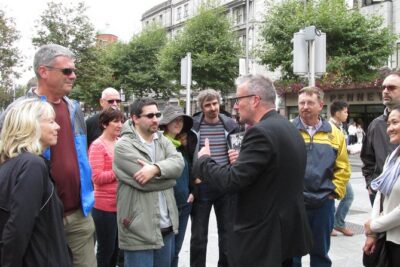

Jeanie Johnston Tall Ship Irish Famine History Tour
Read our review →

Deliciously Dublin: The Artisan Donut Walking & History Tour
Read our review →
Hidden Dublin: Haunted History Walking Tour v2.0 2026
Read our review →
Walking Tour of Dublin’s Viking/Medieval Quarter with a Viking
Read our review →Browse the lists this tour appears in