
Reviewed · DUBLIN HISTORY TOURS
2-Hour Historical Walking Tour from Dublin
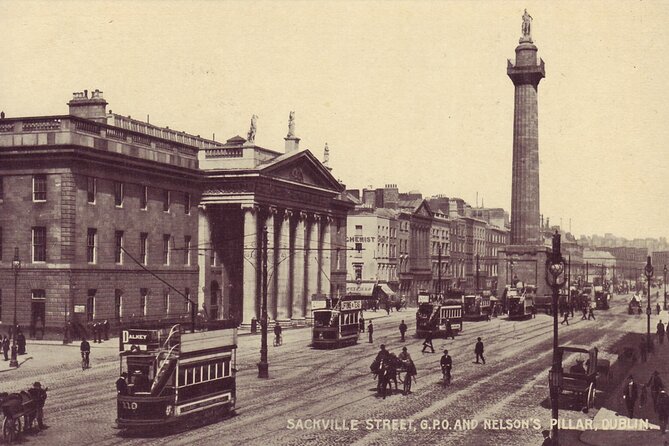
Dublin’s story gets easier to follow when you link its landmarks to the people and conflicts that shaped them. This two-hour walk runs from Trinity College to Christ Church Cathedral, taking in the old parliament, Viking-era archaeology, the Four Courts, City Hall, and Dublin Castle along the way.
I like two things in particular: the guides are history postgraduates, and the route gives you a clear framework for understanding both Dublin and Ireland. I also like the small-group limit of 25, which keeps the walk more personal than a large coach tour.
The main consideration is the depth of the history. The route is short, but the subject matter can be dense, especially when the conversation turns to Irish politics and conflict. If you want a light stroll focused mostly on architecture or modern culture, this may not be your best fit.
- Start at the Grattan statue: Meet opposite Trinity College’s front gate at College Green, not at the gate itself.
- Follow eight historic stops: The route links university, parliament, Viking, legal, religious, and government landmarks.
- Expect history with detail: Guides have included Jody, Eoin, John, Daragh, and Colm, with humor and storytelling alongside political context.
- Book of Kells entry costs extra: You’ll hear about the manuscript at Trinity, but admission is not part of this tour.
- Allow around two hours: The route ends at Christ Church Cathedral, though some walks have run longer.
- Dress for the weather: The walk goes ahead in cold or wet conditions, so comfortable shoes and suitable layers matter.
Dublin’s history, told across eight stops
This is more than a walk past handsome buildings. The guide uses each stop to connect a place with a wider chapter in Dublin’s past, from the city’s Viking origins to the end of British administration in 1922. You’ll cover a compact part of the city, but the historical range is broad.
That approach is useful at the start of a Dublin visit. Once you understand the rough sequence of events, you can return to a landmark later and look at it with more context. The route ends at Christ Church Cathedral, so you can also continue exploring nearby on your own.
The tour is priced at $22.98 per person, with no admission fees included at the stops. For two hours with a history postgraduate guide and a maximum group size of 25, that is a reasonable way to get your bearings, especially if Irish history is a major reason for your trip.
Trinity College and the Book of Kells
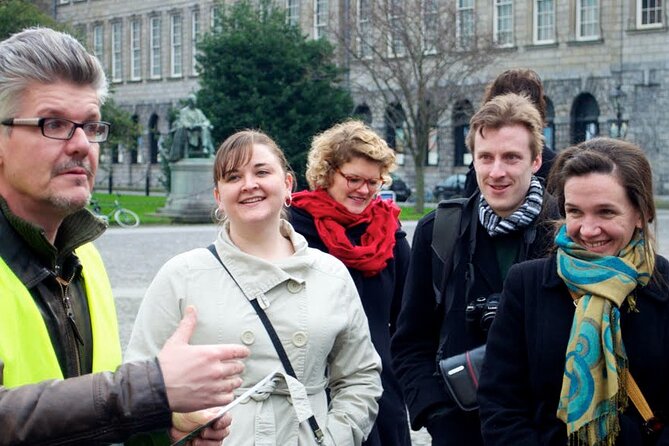
The meeting point is the Henry Grattan Monument on College Green, opposite Trinity College’s front gate. Pay attention to that distinction: the guide meets you at the statue, not at the gate itself. A past mix-up over the meeting location led to a missed tour, so check the precise spot before you set off.
At Trinity, the guide introduces Ireland’s oldest university, founded in 1592, and its best-known treasure, the Book of Kells. This eighth-century manuscript contains the four Gospels in Latin. The tour spends about 20 minutes here, giving you time to hear why the university and the manuscript matter to Ireland’s cultural history.
The tour does not include entry to see the Book of Kells. That’s worth knowing if the manuscript is a priority: this stop provides historical context, not a visit to the exhibition. You can decide separately whether to arrange admission and how to fit it into your day.
More walking tours in Dublin:
- Dublin Highlights and Hidden Gems Guided Walking Tour
★ 5.0 · 6,020 reviews - Dublin: Highlights and Hidden Gems Walking Tour
★ 4.9 · 2,140 reviews - 1916 Rebellion Walking Tour
★ 5.0 · 1,605 reviews
The old parliament at the Bank of Ireland
The next stop shifts from scholarship to power. The Bank of Ireland building was originally Ireland’s colonial parliament, built in 1729. The parliament was abolished by the Act of Union in 1800, a change that helps explain the political weight attached to this site.
The guide also places the building in the era of Protestant Ascendancy and points to its neoclassical architecture. Even if you are not an architecture specialist, the setting helps make the politics less abstract: this was a place where power was represented in stone as well as exercised through law.
Expect about 10 minutes here. The stop is brief, but it gives the route a useful turning point, from Trinity’s academic history to Ireland’s contested political history.
Temple Bar and a district’s second life
Temple Bar is often approached as a place for a meal or a night out. On this walk, its story begins with a plan to demolish the area’s narrow streets. Instead, it was repurposed in the 1990s as Dublin’s Cultural Quarter.
That change offers a quick lesson in how cities remake themselves. The guide can connect the district you see now with a different vision for its future, rather than treating it only as a collection of pubs and busy lanes.
The stop lasts around 10 minutes. It is not a long cultural tour of the neighborhood, so don’t expect time to browse shops or settle in for a drink. Think of it as a short historical pause on the way to older chapters of the city.
Wood Quay and Viking Dublin
At Wood Quay Amphitheatre, the subject reaches back to the Vikings. Extensive archaeological excavation took place here in the 1980s at the site of the Viking city, which was founded in AD 840.
This stop is a reminder that Dublin’s origins predate the later religious and political landmarks on the route. The archaeological story also gives the city a physical past beneath its more familiar streets and buildings. You’ll spend about 10 minutes here, hearing how the Viking settlement fits into the wider account of Dublin’s development.
The appeal is the connection between a present-day urban site and the early city that once stood here. If you are hoping to see a large collection of excavated objects during the tour, that is not part of the stated experience; the focus is the history of the place.
More history tours in Dublin:
- Dublin Historical Centre Food Tour with 8 Food Tastings & Drinks
★ 5.0 · 1,718 reviews - Historical 2-Hour Guided Walking Tour of Dublin
★ 4.7 · 865 reviews - Dublin: Jeanie Johnston Tall Ship Irish Famine History Tour
★ 4.8 · 431 reviews - Dublin’s Haunted History Walking Tour
★ 4.3 · 345 reviews
The Four Courts and the Civil War
The Four Courts is Ireland’s legal headquarters, but its importance on this walk is also tied to a defining political rupture. A Civil War began here in June 1922, between those who supported the Treaty of December 1921 and those who opposed it. That treaty had brought the War of Independence of 1919 to 1921 to an end.
The guide has about 20 minutes at this stop, one of the longer pauses on the route. That extra time makes sense: the events are closely linked, and the political divisions are not easy to reduce to a single sentence. You may find this section especially absorbing if you want to understand how Ireland moved from the War of Independence into conflict over the treaty.
It is also where the tour’s serious, political side becomes most apparent. The guide’s job is to make a complicated sequence understandable, but you’ll need to listen closely and may want to ask questions if you lose the thread.
Christ Church Cathedral and the English invasion
Christ Church Cathedral is described as Dublin’s oldest cathedral, dating to 1030. It was rebuilt in stone in the 1170s by Strongbow, a central figure in the original English invasion of that period.
The stop is brief, about 10 minutes, but it joins religious history to the story of English involvement in Ireland. That link helps explain why a cathedral can be more than a place of worship in a city tour: it can also mark political change and the arrival of new power.
The tour ends at Christ Church Cathedral. This is practical if you want to continue exploring the area afterward, but the walk itself does not promise cathedral admission. Treat the stop as an outside historical introduction unless you have separately confirmed access.
City Hall, Daniel O’Connell, and Catholic Emancipation
At City Hall, the focus turns to Daniel O’Connell, Dublin’s first Catholic Lord Mayor, in 1840. A statue of O’Connell is inside the building. He led the successful campaign for Catholic Emancipation in 1829, ending anti-Catholic laws, and became known as the Liberator.
This stop gives the route a human figure to connect with the wider political story. Instead of moving from one institution to another without a face or voice, you hear about a leader whose campaign changed the legal position of Catholics in Ireland.
The planned stop is about 10 minutes. The listed detail concerns the statue inside City Hall, but the tour information does not specify whether the group enters the building, so don’t assume interior access is included.
Dublin Castle and the city’s name
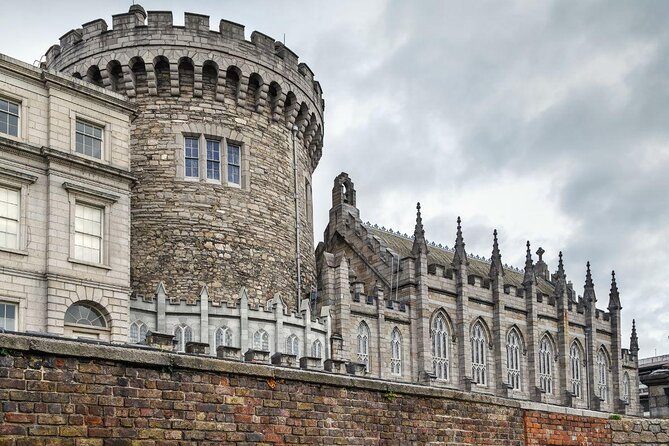
Dublin Castle brings the walk back to the city’s administration. Originally built by King John in 1204, it served as the seat of British administration until 1922. The guide also connects the site to the Dubh Linn, or Black Pool, from which Dublin takes its name.
This is a fitting final chapter for a route that has moved from university and parliament to conflict, religion, and government. The castle’s long role in administration makes the end of British rule in 1922 feel connected to the places you have already seen, rather than an isolated date in a history book.
The listed stop is about 10 minutes. The tour’s stated endpoint is Christ Church Cathedral, so Dublin Castle is part of the route rather than the finish. From Christ Church, you can take the historical framework with you and decide which sites deserve a longer visit.
What the guides bring to the walk
The guides are history postgraduates, and the tour is built around their ability to explain events and make connections between sites. Names associated with the experience include Jody, Eoin, John, Daragh, Caolan, and Colm, though you should not assume a particular guide will lead your departure.
The guiding style can include detailed explanation, humor, stories, and references to more recent history. Jody, for example, has been praised for weaving a long span of Irish history into a clear account, while Eoin has been noted for an easy-to-follow overview and a strong speaking voice. The specific guide changes, but the history-focused approach is central to the tour.
That depth is a strength if you enjoy context and political history. It can be a drawback if you prefer a casual walk with only a few facts at each stop. One account of the tour described the material as too dense and political, and also said the walk ran about half an hour beyond two hours. Plan for roughly two hours, but leave some flexibility if your schedule is tight.
Price, pace, and preparation
At $22.98, the tour offers a focused introduction for less than the cost of many paid attractions. The stops listed do not require admission tickets, and the key extra cost to keep in mind is separate entry to the Book of Kells if you choose to visit it.
The maximum group size is 25. That is large enough to feel like a group tour but smaller than a crowd following a guide through the streets. The walk requires a moderate level of physical fitness, and the route covers a decent stretch of central Dublin, so wear comfortable shoes.
Weather can affect your comfort even when it does not change the historical content. Cold, rain, and wind have all been part of the experience, so bring clothing suited to the forecast. The tour is offered in English, accepts mobile tickets, and has a meeting point near public transportation.
The experience is booked, on average, 21 days ahead. That figure is a planning clue, not a guarantee that every date sells out, but it is sensible to reserve early if you have a fixed arrival date or want this walk near the start of your stay.
Who should book this Dublin walk?
I’d choose this tour if you want a practical introduction to the city and are curious about the forces that shaped Ireland. It is especially useful early in a trip, when the names, dates, and political divisions can help make later visits more meaningful.
It also suits history-minded teenagers and adults who enjoy a guide-led account rather than reading plaques on their own. The walk covers a wide span of time, and the guide may move quickly through complicated events, so it rewards attention.
I’d skip it if you mainly want an easygoing stroll centered on Dublin’s current food, music, or pub culture. Temple Bar is one stop, but the tour’s center of gravity is history, including politics and conflict.
Should you book it?
Book it if you want two hours of guided context for Trinity College, the old parliament, Viking Dublin, the Four Courts, Christ Church, City Hall, and Dublin Castle. The combination of a history postgraduate guide, a compact route, and a modest price makes it a useful first-day orientation.
Choose another kind of walk if you want a lighter overview or have little interest in political history. And if seeing the Book of Kells is your main goal, arrange its admission separately; this tour explains its importance but does not include entry.
FAQ
Where does the tour start?
It starts at the Henry Grattan Monument on College Green, opposite Trinity College’s front gate. Meet at the statue rather than at the gate itself.
Where does the tour end?
The stated endpoint is Christ Church Cathedral, at Christchurch Place in the Wood Quay area.
How long does the walk take?
The tour is approximately two hours. Some departures have run longer, so leave a little flexibility if you have another commitment afterward.
Is admission to the Book of Kells included?
No. The guide discusses the Book of Kells at Trinity College, but entry is not included in the tour price.
How many people can join the group?
The maximum group size is 25 travelers.
What is included in the price?
The included feature is the expertise of a guide who is a history postgraduate. Entry to the Book of Kells is not included.
Can I cancel for a refund?
You can cancel for a full refund at least 24 hours before the experience’s start time. Changes or cancellations made less than 24 hours before the start time are not accepted for a refund.
More two-hour experiences in Dublin
- 2 Hour Walking Tour of Dublin’s City Centre
★ 5.0 · 63 reviews
Recently reviewed in Dublin
- Private Dublin Treasure Hunt Self Guided Tour★ 4.5 · 14 reviews
- Banbridge: Game of Thrones Studio Entry & Tea with Transfers★ 4.8 · 56 reviews
- Dublin Ghost Hunt Exploration Game and Tour★ 4.0 · 34 reviews
- Digby Lock Cruise – Explore Ireland’s Historic Grand Canal.★ 5.0 · 66 reviews
- Drinks on Foot: Dublin Traditional Pub Tour★ 5.0 · 62 reviews
- Dublin Street Art Walking Tour★ 5.0 · 68 reviews
- Dublin Jewellery Forge a Hammered Silver ring:Georges Street★ 5.0 · 59 reviews
- Full-day Award Winning Private Dublin City Highlights Tour★ 4.5 · 62 reviews
Dublin History Tours, compared.

Dublin Historical Centre Food Tour with 8 Food Tastings & Drinks
Read our review →

Historical 2-Hour Guided Walking Tour of Dublin
Read our review →
Jeanie Johnston Tall Ship Irish Famine History Tour
Read our review →

Deliciously Dublin: The Artisan Donut Walking & History Tour
Read our review →
Hidden Dublin: Haunted History Walking Tour v2.0 2026
Read our review →
Walking Tour of Dublin’s Viking/Medieval Quarter with a Viking
Read our review →Browse the lists this tour appears in